Love as a Second Language
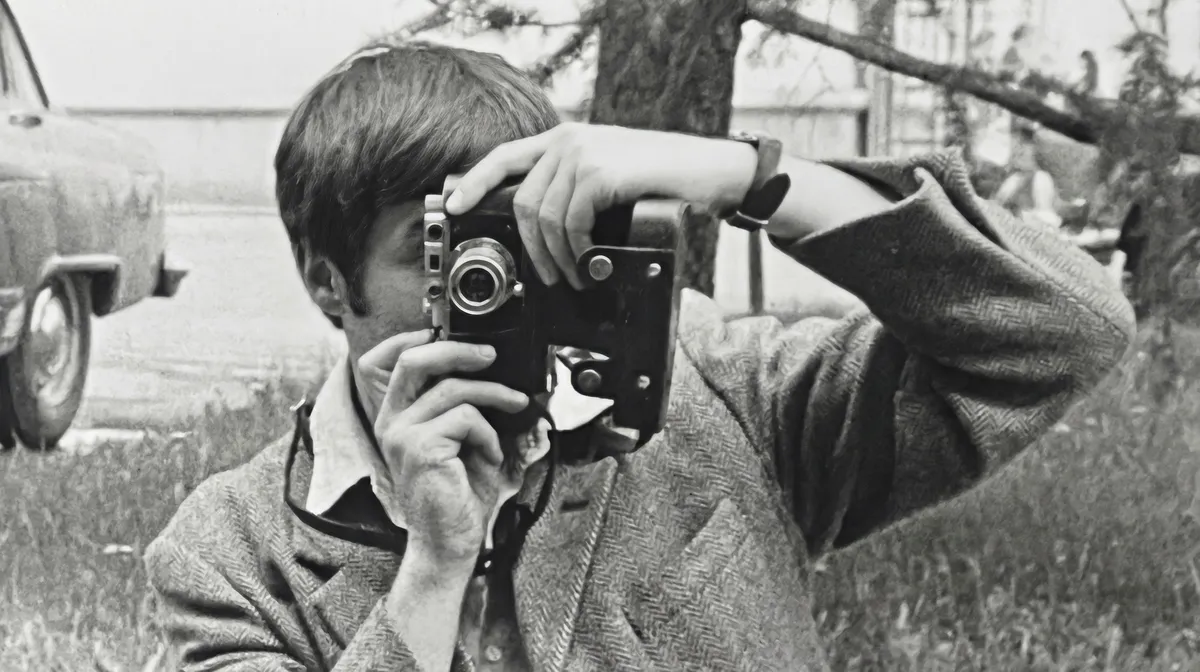
Tongues
My dad and I have always spoken to each other across a gap. At each other, really. I loft a volleyball over the net. What comes sailing back is a hockey puck. I rush to lace up skates, but the next serve is already in the air. I'm always one sport behind.
His English has been frozen at "workable" for a long time. In my teen years, he'd show off a gag trophy that one of his bosses had given him, reading the engraving aloud.
To Arkady: the only man whose English gets worse every year.
He'd crack up, the first note always a long, high squeal - a bow dragged too fast across a string - the rest of the laugh an afterthought.
But he's never been timid about his English. He barrels forward, loudly, speaking as if what he's saying is perfectly clear - even when it isn't. That's him. The doer. When in doubt, do more. Work with what you have.
Russian was the lingua franca of Soviet refugees, and therefore my first language - even though I was born in the States. I only ever spoke it with family. No formal classes. My grandma taught me to read it letter by letter. I got about 80% of the way to fluent and stopped. No special attachment to the culture, no reason to push further. My Russian has been frozen at "workable" for a long time. I don't need a gag trophy to know it gets worse every year.
Neither of us fully crossed over. We approached the middle, pitched our voices across it, and called it close enough.
I have always been translating.
Because my dad's English had stalled, some of the bridging fell on me, mediating between him and the English-speaking world. But you can't translate for someone without modeling their mind. You have to feel your way into what they mean, what they can't say, what they don't realize the other person isn't getting.
It was both a language gap and a world I was bridging - his culture, his way of being. And I wasn't old enough to know that's what it was, when I first got the job.
Wonders
There was another language gap.
When I was five years old, I was fascinated by space. My dad and I would talk about the solar system - how hot Venus was, how big the Great Red Spot on Jupiter was, how long it would take to fly to Mars. He would marshal the same breathless excitement he used for bedtime stories. I was a very small thing, and the night was very large and full of wonders. I remember feeling tiny, feeling connected.
As I got older, my interests sharpened. I'd read something that grabbed me - really get pulled in - and bring it to him, still buzzing, wanting him to feel what I felt, waiting for him to light up the way he had with the planets. It didn't occur to me that I was asking him for something he didn't know how to give. I was just excited.
He'd follow me for a few sentences. Every time: a joke. A pivot. A change of subject.
I was nine or ten the first time I felt the smile leave my face. I'd brought my dad a treasure, and he'd knocked it out of my hand.
I didn't understand why. So I tried again. And again.
I kept bringing him wonders. He kept deflecting. And somewhere in the repetition, the door to that feeling I'd had at five - tiny, connected, marveling together - closed. I couldn't find my way back there.
Doors
Decades later, he told me a story.
When he was five years old, his father placed a chessboard in front of him, beaming. Dad tried to play. His father watched for a few minutes, the smile gradually melting from his face. Then he took the board away and finished his lesson: "You will never be a real chess player." That was the end of chess.
I understood. His father had put a puzzle in front of him, watched him fail, shamed him, and closed the door. When I brought him my articles and questions, I was knocking on that same door.
It was the furthest thing from funny. No wonder he deflected with a joke.
So he became the other thing - the class clown, the one with a tune and a punchline. Those were his languages.
You can hand my dad an instrument he's never seen before - maybe something invented yesterday - leave him alone with it for ten minutes, and he can play it. His hands find the logic of the thing before his mind has a name for it.
That's a man with a different kind of intelligence - one that lives in his hands, in his ear, in some part of him that his father never thought to judge. In music.
He's fluent. He always was. Just not in the language I was speaking.
I wonder sometimes if I became the family's sense-maker because he couldn't be. If some young part of me looked at the door the chessboard had closed on my father, found it unlocked from my side, and walked through. I can figure it out. I'll be that one.
Each year, my curiosity carried me a little further from where he could reach. Each year, he held his ground in the only language he had. We were both just being who we were, shaping each other without knowing it. That's how you build a gap without setting out to build one.
Hands
As a boy, I was obsessed with the cartoon ThunderCats. Perhaps because I asked persistently enough, or perhaps because he wanted a challenge, my dad took his woodworking tools and carved me a Sword of Omens, complete with a woodburned Eye of Thundera above the hilt and a grip small enough for my fingers. I ran around the apartment swinging that sword, imagining I had sight beyond sight.
His hands were - are - workman's hands. A piano tuner's hands. Thick, calloused, always busy. At the kitchen table in the Bronx, I'd watch them reassemble piano hammers and dampers, with tuning forks, strange tools and bits of felt, metal, and wood crowding out the napkin holder and sugar bowl.
Piano tuning was the immigrant's compromise - what a family friend taught him after he arrived in the US, because his training as a musician wouldn't put food on the table.
The job had him driving all over the tri-state area. Every evening he'd get home and spread giant paper maps across the living room floor - worn soft at the creases, some of them torn. He'd chart tomorrow's routes on hands and knees, pants riding down, magnifying glass pressed to the page.
In college, my dad offered to come with me to a concert. I needed to write a paper for a music history class, and we went to Lincoln Center to listen to the Philharmonic perform Tchaikovsky's Fourth Symphony.
During the performance, I sat there trying to hear what I was supposed to hear. Next to me, my dad was scribbling in a shorthand I couldn't read, completely in his element. He'd count out the rhythm under his breath, then look up and away, searching for something in the air before making a few marks in his notebook. Sometimes his pencil rested on the page. Other times it raced to keep up.
Afterwards, he walked me through the entire symphony, movement by movement, his hands beating time on the armrest as he talked. He pointed out things I'd missed - how the conductor had shaped the dynamics, how Tchaikovsky broke convention by writing the scherzo in duple meter, how the oboes handed the melody to the violas. And, because he was a violinist, a few obligatory digs at the viola section that went completely over my head.
He looked like someone who had come home.
This was his domain. And what I saw in him that night - the curiosity, the willingness to go deep - was all I'd ever wanted him to bring to mine.
I got an A on the paper. When I told him, something lit up in his face - not "I'm proud of you" exactly. Maybe pride in himself. He had helped me with a college paper. The piano tuner had just walked his son through Tchaikovsky at an Ivy League school.
I always saw the Sword of Omens. What I didn't know then was that the hands that carved it were trained for concert violin - and that my dad was spending his days tuning other people's pianos to put food on the table.
I always saw the maps on the floor. What I didn't understand as a kid was that those routes represented a man who gave up what he was trained to be and never complained.
I saw his hands beating time on the armrest. What I didn't grasp until later was that it was one of the few times his world and mine overlapped - and how much that must have meant to him.
What took me decades to understand was that his gifts weren't a consolation prize for the connection I wanted. They were everything he had. And he was giving me all of it.
Echoes
Now, when I bring him something - an idea I'm excited about, something I've been thinking through - I already know the shape of what comes back.
He tries. He always tries. He'll listen carefully, ask a question or two, send a warm reply. But the conversation rarely goes deeper. He pivots to photos he's taken. To jokes. He'll send me a video clip of one monkey hitting another with a soup ladle. I can picture him cracking up.
On a recent call, we talked about exercise. I mentioned I mostly do strength training. He asked if I also go for walks. I do - but instead of saying so, I tried to explain how HIIT works, how it gives you cardio without the walking. I was trying to show him I'd thought it through.
He let me finish. Then barreled forward, louder, as if I hadn't said anything: "But do you mostly do WEIGHTS, or do you go for WALKS too?"
When I explain HIIT to my dad, I'm speaking my own language. Go deep. Really understand something. Find the words to bring it back. That's how I reach.
It doesn't land with him. But he asks. I'm learning to hear what he means: I care about you. I'm reaching.
It's still not effortless. I bring him something and feel the conversation close over it. I go quiet when he launches into another joke from a place and time I was never part of. Not everything makes it across.
Offerings
He's 81 now. His body is less able than it was. His life is quieter.
But he still works with what he has. He'll find a twig on the Second Avenue curb, take it home, whittle it down, lacquer it, mount it, make a little art piece. When I visit, he disappears into the other room and brings it out to me, show-and-tell style, proud of it. The same impulse on a smaller canvas.
When your way of loving is doing - when that's how you survived, how you mattered, how you said what you couldn't say with words - what happens when the body can't keep up with the heart?
My dad has never known how to show up empty-handed - and not just with me. For all that didn't translate, his kindness shaped what I look for in people - and what lights me up when I'm lucky enough to find it. He made it seem like the default.
Love, I've come to believe, is not a feeling but a translation. An imperfect rendering of what you mean in your heart, into something the other person can receive. Sight beyond sight.
My dad and I have been translating all my life. Awkwardly, faithfully, across a gap that gets no smaller but somehow matters less every day.
We have always been translating.
And that's love.